The Hierarchy of Controls: Reducing Workplace Hazards
The Hierarchy of Controls is one of the most important concepts in workplace safety. It provides a structured way to reduce risk by choosing the most effective control methods first — not just relying on PPE, training or often unpredictable employee actions. When supervisors and employees understand this hierarchy, they make better decisions, prevent more injuries, and build safer workplaces.
This guide breaks down each level of the hierarchy, explains when to use it, and provides real‑world examples you can apply immediately.
Why the Hierarchy of Controls Matters
Not all controls are created equal. Some eliminate hazards entirely, while others simply reduce exposure. The Hierarchy of Controls helps you:
- Prioritize the most effective solutions
- Avoid over‑reliance on PPE
- Improve the quality of JHAs and hazard assessments
- Strengthen your safety culture
- Reduce injuries and near misses
It’s a core part of hazard identification, risk reduction, and OSHA compliance.
The Five Levels of the Hierarchy of Controls
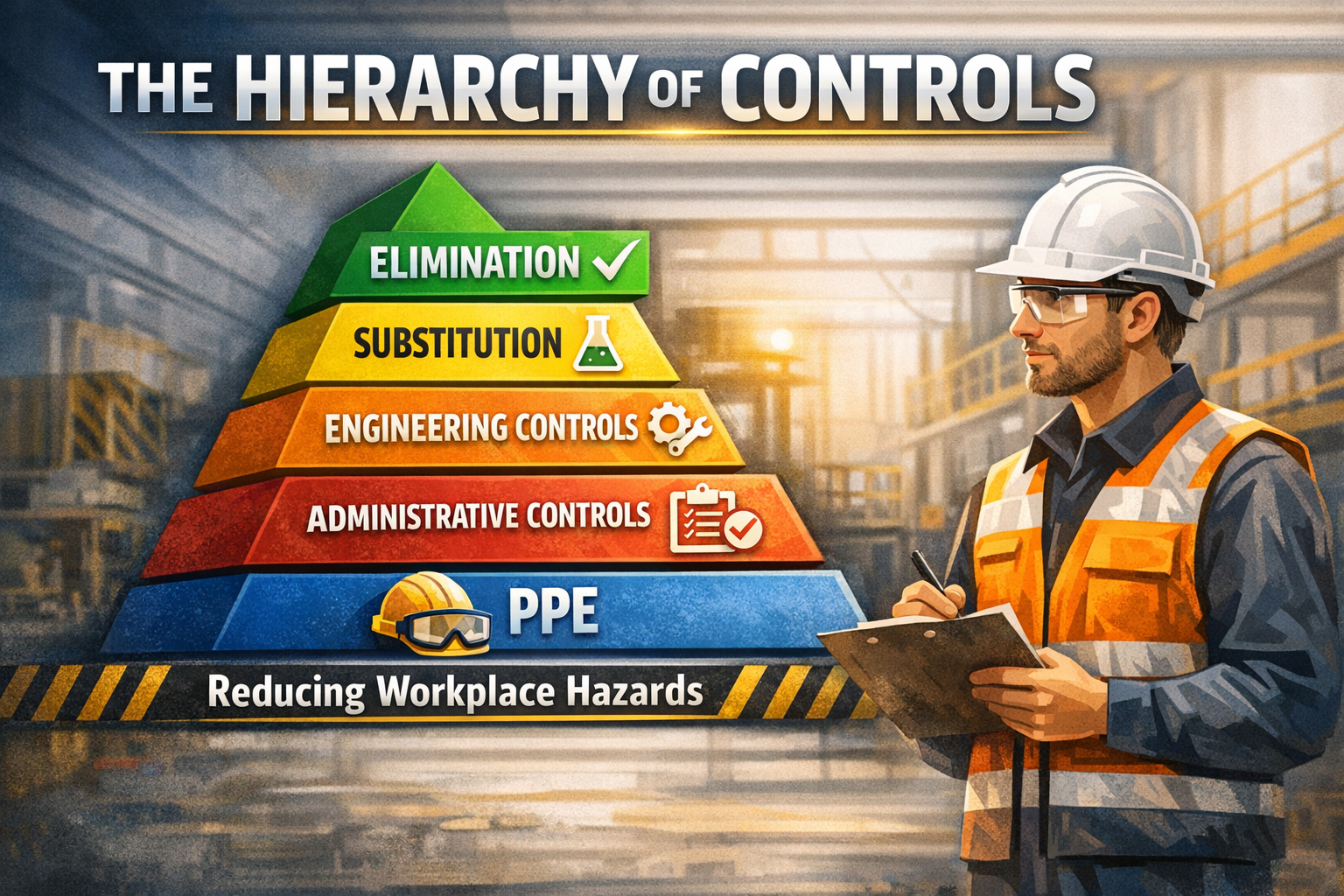
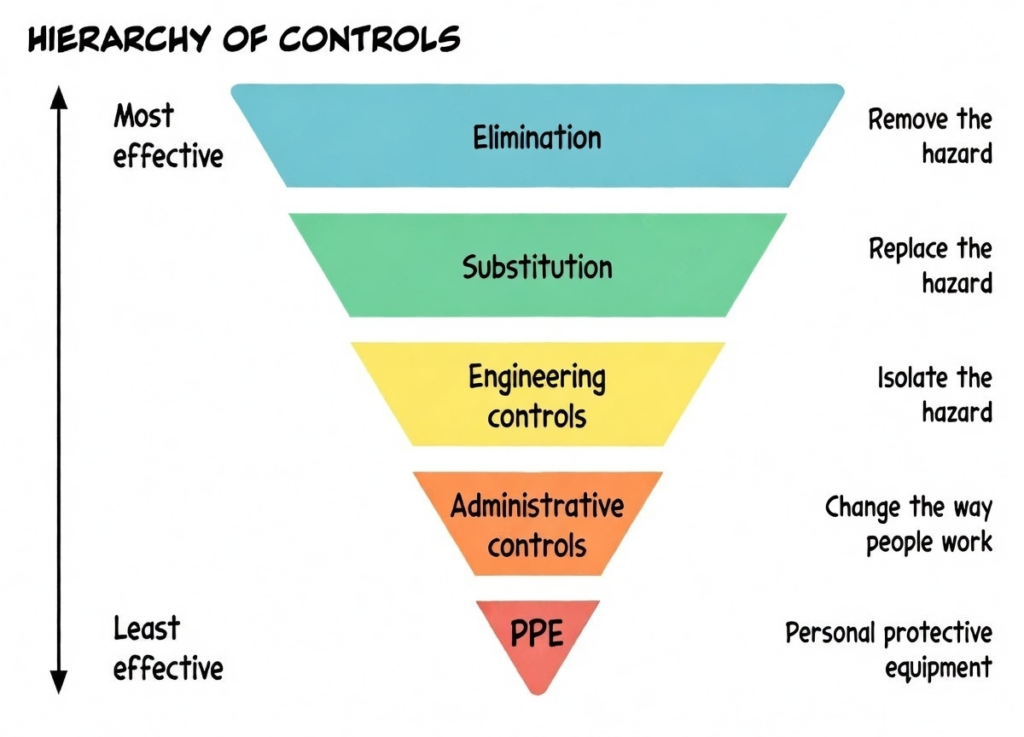
The hierarchy ranks control methods from most effective to least effective:
- Elimination
- Substitution
- Engineering Controls
- Administrative Controls
- Personal Protective Equipment (PPE)
Let’s break down each level with practical examples.
1. Elimination (Most Effective)
Elimination removes the hazard entirely. When a hazard is eliminated, the risk is gone — permanently.
Examples
- Removing unnecessary steps from a task
- Relocating work away from traffic or moving equipment
- Automating a manual process
- Discontinuing the use of a hazardous chemical
When to Use It
- During planning or design
- When reviewing JHAs
- After a near miss or incident
Elimination is the gold standard. If you can remove the hazard, do it. When conducting an incident investigation for a near miss or accident, I would often challenge supervisors and engineers to think outside the box when creating corrective actions. It may not always be achievable, but it’s a great way to get people thinking beyond the low hanging fruit.
2. Substitution
Substitution replaces a hazard with something safer.
Examples
- Using a less toxic chemical
- Replacing a solvent with a water‑based alternative
- Using battery‑powered tools instead of corded tools
- Swapping sharp tools for safer designs
When to Use It
- When elimination isn’t possible
- When safer alternatives exist
- When evaluating new equipment or materials
Substitution reduces risk without changing the task itself.
3. Engineering Controls
Engineering controls isolate people from the hazard. These controls don’t rely on worker behavior — which makes them highly effective.
Examples
- Machine guards
- Ventilation systems
- Barriers and railings
- Lockout/tagout devices
- Noise dampening materials
When to Use It
- When elimination or substitution aren’t feasible
- When the hazard is physical, mechanical, or environmental
- When you need a long‑term, reliable solution
Engineering controls often require investment, but they provide strong, consistent protection.
4. Administrative Controls
Administrative controls change the way people work. They reduce exposure by adjusting procedures, schedules, or expectations.
Examples
- Training and retraining
- Job rotation to reduce ergonomic strain
- Written procedures and checklists
- Safety signage
- Permits and authorization systems
- Limiting time in high‑exposure areas
When to Use It
- When engineering controls aren’t practical
- When hazards are variable or task‑dependent
- When human behavior plays a major role
Administrative controls are helpful — but they rely on people following the rules.
5. Personal Protective Equipment (Least Effective)
PPE protects the worker, not the hazard. It’s important, but it should never be the first or only control.
Examples
- Gloves
- Hard hats
- Respirators
- Safety glasses
- Hearing protection
When to Use It
- When no other controls are feasible
- As a temporary measure
- As a final layer of protection
PPE is essential — but it’s the last line of defense.
Real‑World Examples of Applying the Hierarchy
Example 1: Grinding Metal
Hazards: flying debris, noise, sparks Controls:
- Elimination: Outsource grinding to a vendor
- Substitution: Use a less aggressive grinding wheel
- Engineering: Install spark guards and local exhaust
- Administrative: Training, signage, restricted access
- PPE: Face shield, gloves, hearing protection
Example 2: Chemical Cleaning
Hazards: fumes, skin contact, fire risk Controls:
- Elimination: Switch to mechanical cleaning
- Substitution: Use a water‑based cleaner
- Engineering: Ventilation, closed systems
- Administrative: SDS review, training, storage rules
- PPE: Gloves, goggles, apron
Example 3: Working at Heights
Hazards: falls, dropped objects Controls:
- Elimination: Perform work from the ground
- Substitution: Use extendable tools
- Engineering: Guardrails, scaffolding
- Administrative: Fall protection training, spotters
- PPE: Harness and lanyard
How the Hierarchy Improves JHAs
The Hierarchy of Controls is the backbone of a strong Job Hazard Analysis. When completing a JHA:
- Identify hazards
- Evaluate risk
- Apply controls starting at the top of the hierarchy
- Avoid jumping straight to PPE
- Reassess when conditions change
This approach leads to better controls and safer work. Need help understanding the aspects of a JHA? Job Hazard Analysis (JHA): A Practical, Step‑by‑Step Framework
Common Mistakes to Avoid
- Relying only on PPE
- Choosing administrative controls when engineering is possible
- Failing to reassess controls after incidents
- Not involving employees in decision‑making
- Treating the hierarchy as optional
The hierarchy works best when it’s applied consistently.
Conclusion
The Hierarchy of Controls is a simple but powerful framework for reducing workplace hazards. By prioritizing elimination, substitution, and engineering controls — and using administrative controls and PPE as supporting layers — you create safer, more reliable systems that protect employees every day.
Use this guide to strengthen your JHAs, improve your training, and build a safer workplace culture.