

Understanding OSHA’s General Duty Clause: What It Covers and Why It’s Often Misunderstood
Why the General Duty Clause Matters More Than Most Employers Realize
Most employers understand OSHA through its specific standards — machine guarding, fall protection, hazard communication, electrical safety, and so on. But what many don’t realize is that OSHA can (and frequently does) cite employers even when no specific standard applies.
That authority comes from the General Duty Clause, a short but powerful section of the Occupational Safety and Health Act that requires employers to provide a workplace “free from recognized hazards.”
This clause is often misunderstood, misquoted, and underestimated. Yet it plays a major role in OSHA enforcement, especially for emerging hazards, industry‑specific risks, and situations where no detailed regulation exists.
This article breaks down exactly what the General Duty Clause covers, how OSHA interprets it, and what employers must do to stay compliant.
What Is OSHA’s General Duty Clause?
The General Duty Clause is found in Section 5(a)(1) of the Occupational Safety and Health Act of 1970. It states:
“Each employer shall furnish to each of his employees employment and a place of employment which are free from recognized hazards that are causing or are likely to cause death or serious physical harm.”
This single sentence gives OSHA broad authority to cite employers for hazards that:
- Are recognized
- Are hazardous
- Are correctable
- Are not addressed by a specific OSHA standard
In other words, the General Duty Clause is OSHA’s catch‑all requirement for workplace safety.
Why the General Duty Clause Exists
OSHA cannot possibly write a specific standard for every hazard in every industry. Workplaces evolve, technology changes, and new risks emerge constantly.
The General Duty Clause fills the gaps by ensuring employers still have a legal obligation to protect workers even when:
- A hazard is new
- A hazard is unique to a specific industry
- A hazard is well‑known but not regulated
- A hazard is difficult to regulate with a one‑size‑fits‑all rule
This clause ensures OSHA can act when a hazard is obvious, serious, and preventable — even if no regulation explicitly addresses it.
The Four Elements OSHA Must Prove in a General Duty Clause Citation
OSHA cannot simply cite an employer because “something seems unsafe.” To issue a General Duty Clause citation, OSHA must prove all four of the following:
1. A Hazard Exists
There must be a real, identifiable hazard — not a theoretical or speculative one.
Examples:
- Employees exposed to extreme heat
- Workers threatened by violent customers
- Repetitive motion injuries from poor workstation design
- Combustible dust accumulation
- Unguarded conveyor pinch points (if no specific standard applies)
2. The Hazard Is Recognized
A hazard is considered “recognized” if:
- The industry acknowledges it
- The employer acknowledges it
- Common sense acknowledges it
- OSHA guidance acknowledges it
Recognition can come from:
- Industry consensus standards (ANSI, NFPA, ASME)
- Manufacturer instructions
- Safety data sheets
- Industry best practices
- Prior incidents or near misses
- Internal safety policies or assessments
If the hazard is widely known, OSHA considers it recognized.
3. The Hazard Is Likely to Cause Death or Serious Harm
OSHA must show that the hazard could realistically cause:
- Fatality
- Amputation
- Permanent disability
- Serious injury
- Long‑term health effects
This is why the General Duty Clause is not used for minor hazards.
4. A Feasible Method Exists to Correct the Hazard
OSHA must show that the employer could have taken reasonable steps to eliminate or reduce the hazard.
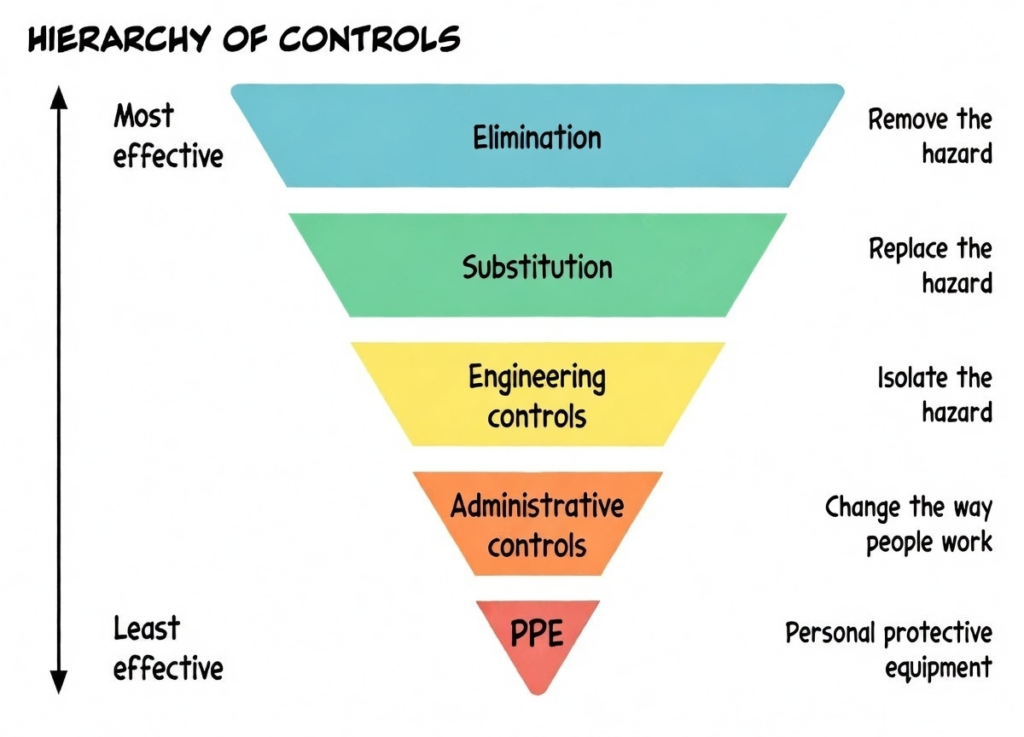
Examples:
- Installing barriers
- Implementing training
- Adjusting work practices
- Providing PPE
- Improving ventilation
- Adding administrative controls
If a feasible solution exists, OSHA can cite the employer.
Common Examples of General Duty Clause Citations
The General Duty Clause is used most often for hazards that lack specific OSHA standards. Here are the most common categories.
1. Heat Stress
Heat illness is one of the most frequent General Duty Clause citations because OSHA does not yet have a specific heat standard.
OSHA uses:
- NIOSH criteria
- ACGIH TLVs
- Industry best practices
…to show that heat is a recognized hazard.
2. Workplace Violence
There is no OSHA standard for workplace violence, but OSHA frequently cites employers under the General Duty Clause when:
- Employees face threats from customers or patients
- Employers fail to implement controls
- Prior incidents show a pattern
Healthcare, retail, and social services are common targets.
3. Ergonomics and Musculoskeletal Disorders
OSHA once had an ergonomics standard, but it was repealed. Today, ergonomics hazards are cited under the General Duty Clause when:
- Repetitive motion injuries occur
- Workstations are poorly designed
- Lifting tasks exceed safe limits
OSHA often references NIOSH lifting guidelines.
4. Combustible Dust
There is no single OSHA standard for combustible dust, but OSHA uses:
- NFPA standards
- Industry guidance
- Past explosion data
…to show that dust accumulation is a recognized hazard.
5. Infectious Diseases (Historical Context)
During the COVID‑19 pandemic, OSHA used the General Duty Clause to cite employers who:
- Failed to implement basic controls
- Ignored CDC guidance
- Exposed workers to known transmission risks
This demonstrated how the clause applies to emerging hazards.
Why the General Duty Clause Is Often Misunderstood
Many employers mistakenly believe:
- “If there’s no OSHA standard, I can’t be cited.”
- “The General Duty Clause only applies to extreme hazards.”
- “OSHA can’t enforce guidelines or recommendations.”
All three are incorrect.
OSHA can — and often does — cite employers for hazards that:
- Are well‑known
- Are documented
- Have feasible controls
- Are not covered by a specific standard
The General Duty Clause is broad by design.
How Employers Can Stay Compliant
Compliance with the General Duty Clause is not about memorizing regulations — it’s about building a proactive safety system.
Here’s what OSHA expects.
1. Identify Hazards Before OSHA Does
Employers must:
- Conduct regular hazard assessments
- Perform Job Hazard Analyses (JHAs)
- Review incident and near‑miss data
- Inspect equipment and work areas
- Monitor industry trends
We have a free tool to help employers build and document Job Hazard Analyses.
Job Hazard Analysis (JHA) Builder
2. Document Recognized Hazards
Documentation is your best defense.
Examples:
- JHAs
- Safety meeting notes
- Training records
- Manufacturer instructions
- SDS sheets
- Maintenance logs
If OSHA sees no documentation, they assume no action was taken.
3. Implement Feasible Controls
Controls may include:
- Engineering controls (guards, ventilation, barriers)
- Administrative controls (procedures, rotation, signage)
- PPE (as a last resort)
- Training and retraining
- Policy updates
OSHA expects employers to choose the most effective feasible control.
4. Train Employees on the Hazard
Training must be:
- Documented
- Specific to the hazard
- Provided in a language employees understand
- Refreshed periodically
Training is often the difference between a citation and a warning.
5. Review Industry Standards and Best Practices
Even if OSHA doesn’t have a standard, they often reference:
- ANSI
- NFPA
- ASME
- ACGIH
- NIOSH
- Manufacturer guidelines
If your industry recognizes a hazard, OSHA expects you to recognize it as well.
What Happens If You’re Cited Under the General Duty Clause?
A General Duty Clause citation follows the same process as any OSHA citation:
- Inspection
- Hazard identification
- Citation issuance
- Abatement requirements
- Penalties
- Follow‑up inspections
Penalties can be significant, especially if:
- The hazard is severe
- The employer had prior knowledge
- The employer failed to act
How Employers Can Defend Against a General Duty Clause Citation
Employers can challenge a citation by arguing:
- The hazard was not recognized
- The hazard did not pose serious harm
- No feasible controls existed
- OSHA’s evidence is insufficient
- The employer took reasonable steps to protect workers
However, these defenses are difficult if documentation is weak.
The General Duty Clause and Safety Culture
The General Duty Clause is more than a legal requirement — it’s a reflection of your safety culture.
Employers who excel at:
- Hazard identification
- Employee involvement
- Training
- Documentation
- Continuous improvement
…rarely face General Duty Clause citations.
Those who struggle with these fundamentals are at higher risk.
Final Thoughts
The OSHA General Duty Clause is one of the most important — and most misunderstood — parts of workplace safety compliance. It fills the gaps where no specific standard exists and ensures employers remain responsible for protecting workers from recognized hazards.
Understanding how OSHA interprets the clause, how citations are issued, and what employers must do to stay compliant is essential for maintaining a safe workplace and avoiding costly enforcement actions.
By proactively identifying hazards, documenting controls, training employees, and staying informed about industry best practices, employers can meet their obligations under the General Duty Clause and build a stronger, safer workplace.