Bonding and Grounding: Your Complete Guide to Controlling Static Electricity in the Workplace
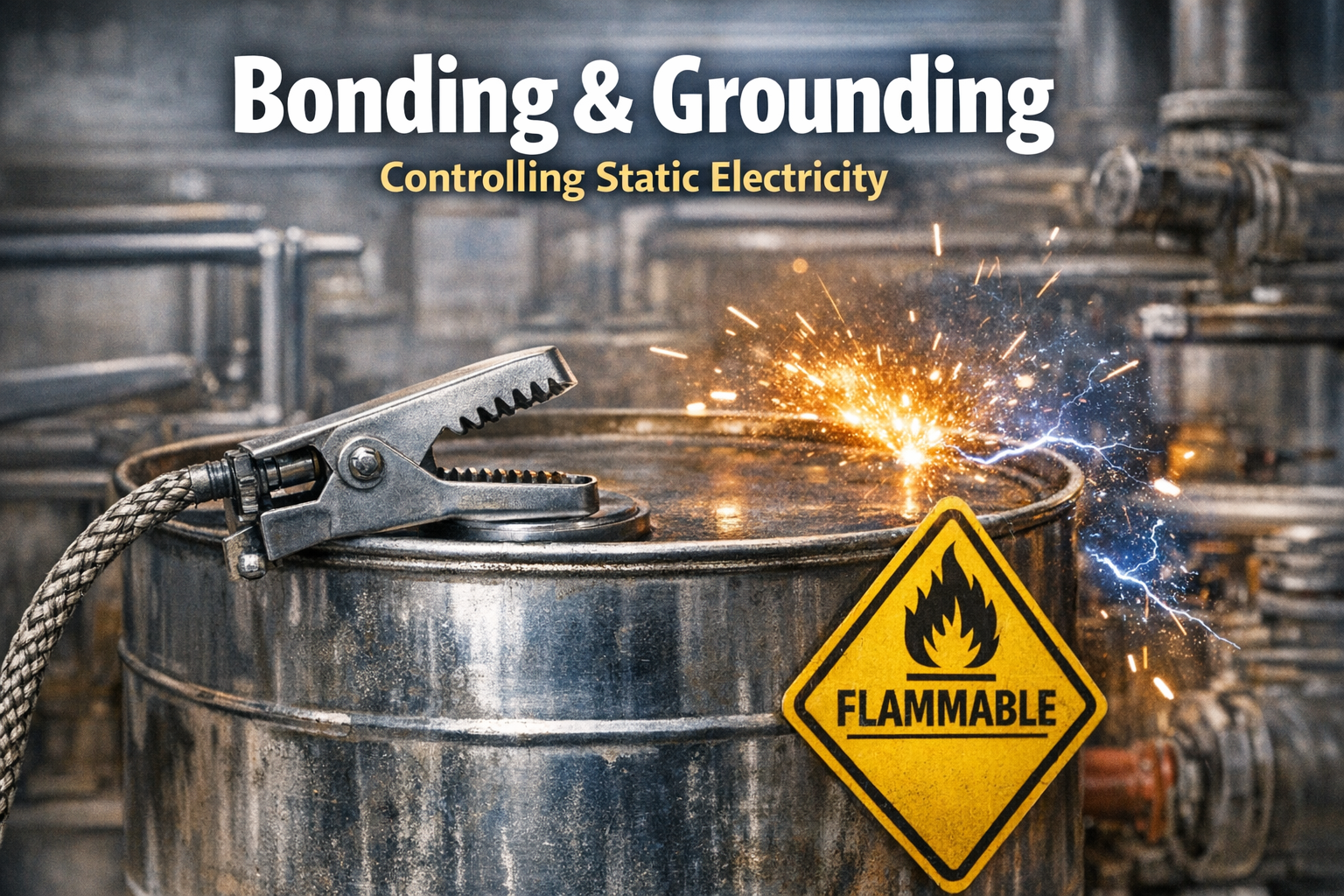
The flash was so brief I almost missed it. A tiny blue spark jumped between the drum lid and the metal funnel as a maintenance technician poured solvent from one container to another. The spark itself was harmless, maybe a quarter inch long, barely visible in the afternoon light. But in that moment, with flammable vapors present, that innocent little spark could have triggered an explosion that destroyed the facility and killed everyone nearby.
Fortunately, we’d implemented proper bonding and grounding protocols six months earlier. The technician had connected both containers with a bonding cable before starting the transfer, and everything was grounded to a proper earth connection. That visible spark was actually proof the system was working; it showed static charge dissipating safely through our grounding system rather than building up to dangerous levels.
Static electricity is one of those hazards that seems almost quaint until it isn’t. We’ve all experienced the annoying shock from touching a doorknob or the way our hair stands up after removing a winter hat. These everyday experiences make static electricity feel harmless, even amusing. But in industrial environments where flammable liquids, combustible dusts, or explosive atmospheres exist, static discharge can be catastrophic. Let’s talk about how to control it.
Understanding Static Electricity: More Than Just Annoying Shocks
Before we can control static electricity, we need to understand what it actually is. Static electricity occurs when electrical charges build up on the surface of materials. This happens through a process called triboelectric charging—essentially, friction between different materials causes electrons to transfer from one surface to another.
Picture pouring liquid from one container to another. As the liquid flows, it rubs against the container walls and the receiving vessel. This friction strips electrons from the liquid molecules, leaving them with a positive charge while the electrons accumulate elsewhere, creating a negative charge. The faster you pour, the more friction occurs, and the more charge builds up.
Here’s the critical part: these charges want to equalize. They’re looking for a path to discharge, and they’ll jump through air if the voltage gets high enough. That jump, that spark, is static discharge. In normal air, it takes about 3,000 volts to create a visible spark. Sounds like a lot, but you can easily generate 20,000 volts or more just by shuffling across a carpet on a dry day.
The problem isn’t the voltage itself. Your body can safely handle these high voltages at the extremely low currents involved in static discharge. The problem is what happens when that discharge occurs in the presence of flammable vapors or combustible materials. Even a tiny spark, one you might not even see or feel, can have enough energy to ignite certain vapor-air mixtures.
When Static Becomes Dangerous: Identifying Your Risks
Not every workplace needs extensive static control measures. The hazard exists primarily when you have both static generation and ignitable atmospheres in the same location. Let me walk through the specific scenarios where static electricity becomes a serious concern.
Flammable Liquid Handling
This is the most common scenario in manufacturing facilities. Any time you transfer flammable liquids, gasoline, solvents, alcohols, many cleaning chemicals, you’re generating static electricity. The liquid flowing through pipes or hoses, splashing into containers, or moving through filters all create triboelectric charging.
The danger peaks during filling operations. As you fill a container with flammable liquid, the space above the liquid contains flammable vapors. If static discharge occurs in that vapor space, you can get an explosion. I’ve investigated incidents where workers were filling 55-gallon drums with solvent and caused fires because they didn’t ground the containers first.
The risk increases dramatically with low-conductivity liquids like toluene, hexane, or gasoline. These liquids can’t dissipate static charges internally, so the charge just keeps building. High-flow rates, splashing, and fine filtration all make the problem worse by generating more charge more quickly.
Combustible Dust Operations
Combustible dust presents a different kind of static hazard. When dust particles flow through pneumatic conveying systems, get poured from bags, or move through processing equipment, they generate static charges just like liquids do. The difference is that dust particles can hold onto their charge for much longer.
A facility near to where I live processes powdered sugar. Sounds harmless, right? But powdered sugar is highly combustible. They were experiencing small flash fires in their dust collection system because static discharge was igniting the dust-air mixture. The operators had no idea static electricity was even a concern with a food product.
Dust operations create a second problem: layers of accumulated dust on surfaces can become charged. Walk across a dusty floor wearing insulating shoes, and you can build up enough charge to create an incendiary spark when you touch grounded metal equipment.
Spray Operations and Powder Coating
Any operation that atomizes liquid or powder creates significant static. Paint spraying, powder coating, and aerosol applications all involve breaking material into tiny droplets or particles. This process maximizes surface area and friction, generating enormous static charges.
In spray booths, you’ve got a perfect storm for static ignition: flammable vapors, charged particles in the air, and people moving around generating body static. Without proper grounding and bonding, it’s not a question of if you’ll have an incident, but when.
Bonding vs. Grounding: Understanding the Difference
Here’s where many safety professionals—even experienced ones—get confused. Bonding and grounding are related but distinct concepts, and you need both for effective static control. Let me clear up the distinction.
Bonding: Equalizing the Charge
Bonding means connecting two or more conductive objects together electrically so they have the same electrical potential. When you bond containers together during liquid transfer, you’re creating an electrical connection that allows charges to flow between them.
Think of bonding like this: if you have two metal containers at different charge levels, connecting them with a bonding cable allows the charges to equalize between them. One container might be at +10,000 volts and the other at ground potential (0 volts). When you bond them together, they both end up somewhere in between—maybe +5,000 volts each.
The key point is that bonding prevents a spark from jumping between the two objects. As long as they’re at the same potential, there’s no voltage difference to drive a spark. This is why we bond the fill nozzle to the receiving container during flammable liquid transfers—so no spark can jump between them, even if both are charged relative to earth ground.
Grounding: Connecting to Earth
Grounding means connecting conductive objects to earth ground—literally, a connection that goes into the ground outside your building. This provides a path for static charges to flow away to earth, which has essentially unlimited capacity to absorb electrical charge.
Going back to our example: if you bond two containers together and then ground one of them, both containers discharge to earth potential (0 volts). The charges don’t just equalize between the containers; they dissipate completely into the earth.
Grounding is critical because it prevents charge accumulation in the first place. Instead of building up tens of thousands of volts, charges flow continuously to ground as they’re generated. This keeps voltage levels low enough that ignition-capable sparks can’t occur.
Why You Need Both
Here’s a real-world example that shows why bonding alone isn’t enough. Imagine you’re transferring solvent from a metal drum to a metal safety can, and you’ve bonded them together with a cable. Great—no spark can jump between them. But what if your drum is sitting on a wooden pallet and your safety can is on a non-conductive plastic cart? Neither one is grounded.
As you pour, static charges build up in both containers equally (because they’re bonded). The voltage rises: 5,000 volts, 10,000 volts, 15,000 volts. Eventually, you touch one of the containers with your hand, which is at ground potential because you’re standing on a concrete floor. Spark! The charge jumps from the container through your body to ground, right through the flammable vapor space.
If you’d grounded the system, the charges would have flowed to earth continuously as they were generated, never building up to dangerous levels. This is why the rule is simple: bond all containers together, and ground at least one of them.
Implementing Effective Bonding and Grounding Systems
Understanding the concepts is one thing; implementing them correctly in your facility is another. Let me walk through the practical requirements for effective static control.
Proper Grounding Points
Your grounding system is only as good as your connection to earth ground. Many facilities have designated grounding points—these might be copper rods driven deep into the earth, connections to the building’s electrical grounding system, or properly grounded structural steel.
The key requirement is that the grounding point must have less than 10 ohms resistance to earth. Some standards require less than 1 ohm for certain applications. You can’t just connect to any random metal pipe or structural member and assume it’s grounded. I’ve seen cases where workers connected their grounding cables to metal that was actually isolated from earth ground—essentially creating a bonding connection to nowhere.
Test your grounding points regularly with a ground resistance tester. This simple check can catch problems like corroded connections, broken ground rods, or isolated building steel before they cause incidents. In critical operations, install continuous ground monitoring systems that alert you immediately if ground connections are lost.
Bonding Cable Requirements
Not every cable is suitable for bonding. The requirements are actually quite specific, and I’ve seen numerous facilities using inadequate bonding cables without realizing it.
First, the cable must be capable of conducting electricity. This seems obvious, but I’ve encountered facilities using nylon rope or other non-conductive materials that they thought were bonding cables. Use copper wire, typically 12 AWG (American Wire Gauge) or larger for fixed installations, and 18 AWG or larger for portable bonding cables.
Second, the connections matter as much as the cable. While many organizations have moved away from using them, Alligator clips are still common for portable bonding cables, but they must make good metal-to-metal contact with clean, unpainted surfaces. I recommend clips with sharp teeth that bite through surface contamination. For permanent installations, use welded or bolted connections with star washers to maintain contact even if paint or corrosion develops.
Third, cable length matters for some applications. While bonding cables don’t strictly need to be short (electricity moves fast enough that cable length isn’t the limiting factor), shorter cables are less likely to get damaged, disconnected, or create trip hazards. I typically recommend keeping portable bonding cables under 10 feet for practical reasons.
Container and Equipment Grounding
Different containers and equipment types require different grounding approaches. Metal drums and containers are straightforward; attach your grounding cable to the metal body, making sure you’ve got good contact with bare metal. For painted containers, the bonding cable must connect to a clean spot where you can verify metal-to-metal contact.
Portable tanks and intermediate bulk containers (IBCs) need permanent grounding lugs installed. These are dedicated connection points that ensure you can always establish a reliable ground. I’ve seen too many incidents where workers tried to clip grounding cables to IBC frames or fittings that weren’t actually conductive paths to the container contents.
For mixing vessels, reactors, and process equipment, the grounding connection typically ties into the equipment’s electrical bonding system. But don’t assume equipment is automatically grounded just because it’s plugged in electrically. The electrical ground protects against electrical faults, but it may not provide adequate static grounding if there are isolating flanges, non-conductive gaskets, or other breaks in the conductive path.
Special Considerations for Non-Conductive Containers
Plastic, fiberglass, and other non-conductive containers present a special challenge. You can’t ground them because they won’t conduct electricity. The static charge stays on the surface of the liquid inside, and you can’t do anything about it from the outside.
The solution isn’t grounding; it’s controlling the charge generation and eliminating ignition sources. This means using slower fill rates to reduce static generation, using conductive hoses that extend to the bottom of the container (reducing splashing), allowing adequate relaxation time for charges to dissipate, and ensuring the surrounding atmosphere remains non-flammable.
Some facilities use conductive plastic containers that have carbon or metal fibers embedded in the plastic to make them conductive. These can be grounded like metal containers, but you must verify conductivity with a meter—not all containers labeled as “conductive” actually meet the required resistance standards (typically less than 10^6 ohms).
Procedural Controls: Making Bonding and Grounding Happen
Having the right equipment doesn’t help if workers don’t use it correctly. The most common failure mode I see isn’t equipment failure, it’s procedural failure. Workers skip steps, make assumptions, or find workarounds that defeat the static control system.
Standard Operating Procedures
Every operation involving flammable materials needs written procedures that explicitly address bonding and grounding. Don’t just add a line that says “ground containers”; spell out exactly what that means. Which containers? Where’s the grounding point? What cable should be used? How do you verify the connection?
I recommend a checklist approach for critical transfers. Before starting, operators must verify: grounding cable connected, bonding cables in place, visual confirmation of metal-to-metal contact, no damage to cables or clamps. Some facilities use ground monitoring systems that won’t allow pumps to start unless proper grounding is detected.
The procedure must also address the sequence of connections and disconnections. Always ground and bond before starting liquid flow. Always stop liquid flow before disconnecting bonds and grounds. This simple sequence prevents the most common spark scenarios.
Training That Sticks
I can’t count how many times I’ve investigated static electricity incidents where the workers had been “trained” on bonding and grounding but clearly didn’t understand why they were doing it. They viewed it as a bureaucratic requirement rather than a critical safety control.
Effective training explains the hazard, not just the procedure. Show workers what happens when static ignites flammable vapors, there are plenty of videos available. Explain why both bonding and grounding are necessary. Demonstrate with a multimeter how charge builds up during transfers and how grounding dissipates it.
Use hands-on training with the actual equipment workers will use. Have them practice connecting bonding cables, verifying connections, and identifying improper setups. Include scenarios where the “obvious” grounding point isn’t actually grounded, or where bonding cables have corroded connections that won’t conduct.
Verification and Testing
How do you know your bonding and grounding system is actually working? Hope isn’t a strategy. You need regular testing and verification.
For permanent grounding points, test resistance to earth ground at least annually. Any reading above 10 ohms requires investigation and correction. For bonding cables, test continuity regularly; you should see less than 1 ohm of resistance end-to-end. Damaged cables, corroded connections, or broken wires will show up in these tests.
I recommend keeping a simple multimeter in areas where bonding and grounding is required. Train operators to do quick continuity checks before critical transfers. It takes 30 seconds to verify a bonding cable has good continuity, but it can prevent a catastrophic incident.
Some facilities use continuous monitoring systems for critical operations. These systems verify that grounding connections exist and maintain less than a specified resistance (often 10 ohms or 1 megohm depending on the application). If the connection is lost, an alarm sounds or the process automatically shuts down.
Common Mistakes and How to Avoid Them
After years of conducting audits and investigating incidents, I’ve seen the same mistakes repeated across industries. Let me share the most common ones so you can avoid them.
Assuming Piping Provides Grounding
Many workers assume that if liquid flows through metal piping into a vessel, the piping automatically provides grounding. This is dangerous thinking. Flanges with non-conductive gaskets, plastic pipe sections, flow meters with insulating components, and threaded connections with PTFE tape can all create breaks in the conductive path.
Never assume piping provides adequate grounding. Always establish a dedicated ground connection to the receiving vessel using a proper grounding cable. If you’re unsure whether your piping provides a conductive path, measure the resistance from the vessel back to your grounding point. Anything over 1 megohm means the piping isn’t a reliable ground path.
Using Inadequate Bonding Cables
I’ve seen facilities using lamp cord, speaker wire, and even rusty coat hangers as bonding cables. Others use cables with corroded clamps that can’t make good contact. These improvised solutions provide a false sense of security; workers think they’re bonded when they’re not.
Invest in proper bonding cables designed for the purpose. They’re not expensive, and the cost is trivial compared to the consequences of an explosion. Inspect cables regularly and replace them at the first sign of damage, corrosion, or worn clamps.
Bonding After Starting the Transfer
This seems like it shouldn’t need to be said, but I’ve watched workers start pumping flammable liquid and then scramble to connect bonding cables while the transfer is in progress. By the time they connect, static charge has already built up, and the act of connecting can actually trigger a spark.
The sequence must be: connect all bonds and grounds, then start the transfer. Never connect or disconnect bonding/grounding cables while flammable liquid is flowing or while vapors are present.
Ignoring Environmental Factors
Static electricity problems get worse in low-humidity conditions. When relative humidity drops below 30%, static charges dissipate much more slowly from surfaces. Some materials that are normally conductive enough become problematic in very dry conditions.
Pay extra attention to bonding and grounding during winter months when indoor heating creates very low humidity. Some facilities use humidification systems in critical areas to maintain humidity above 40%, which significantly reduces static accumulation. However, humidity control alone is never sufficient; you still need proper bonding and grounding.
Beyond the Basics: Advanced Static Control
For some operations, basic bonding and grounding isn’t enough. Let me touch on some advanced static control measures for high-hazard operations.
Ionization Systems
Static eliminators or ionizers work by flooding the air with charged ions that neutralize static charges on surfaces and particles. These are particularly useful for non-conductive materials that can’t be grounded, or for processes where grounding alone doesn’t eliminate the hazard.
Common applications include web handling (paper, plastic film), powder handling, and spray operations. The ionizers create a balanced mix of positive and negative ions that attach to charged surfaces, neutralizing the static charge without any physical contact.
Conductive Flooring and Footwear
In environments where walking across floors can generate dangerous static charges, conductive or static-dissipative flooring provides a grounding path. Combined with conductive footwear, this allows static charges to drain from workers’ bodies continuously instead of accumulating until they touch grounded equipment.
This approach is common in electronics manufacturing, but it’s equally important in facilities handling combustible dusts or working with extremely sensitive flammable atmospheres. Test the floor-to-ground resistance regularly, and ensure workers understand they must wear the proper footwear for the system to work.
The Bottom Line on Static Control
Static electricity seems like such a minor hazard compared to the mechanical, chemical, and other risks we manage daily. But its very familiarity breeds complacency. We’ve all experienced harmless static shocks hundreds of times, making it hard to take the industrial hazard seriously.
The reality is that static electricity is a leading cause of fires and explosions in facilities handling flammable materials. The incidents are sudden, devastating, and completely preventable. Every investigation I’ve conducted found the same root cause: inadequate or improperly implemented bonding and grounding.
The good news is that static control is neither complicated nor expensive. Bond containers together during transfers. Ground metal containers and equipment to earth. Use proper cables and connections. Follow procedures consistently. Verify your systems periodically. These simple measures eliminate the vast majority of static ignition risks.
Start by identifying where you generate static and where you have ignitable atmospheres. Anywhere those two factors overlap, you need bonding and grounding controls. Write clear procedures, train people thoroughly, and verify compliance. The few minutes spent properly bonding and grounding before each transfer is infinitely better than investigating why your facility burned down.
What static control challenges have you encountered in your workplace? Have you implemented creative solutions that work particularly well? Share your experiences in the comments. We all learn from each other’s real-world applications of these critical safety principles.